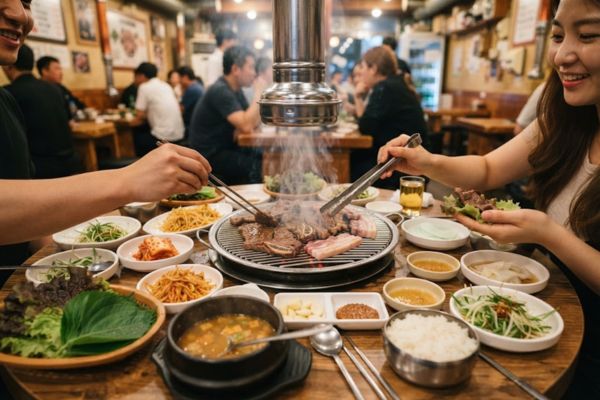
If you’ve never had Korean BBQ in Korea before, the whole thing can look a little intimidating.
There’s a grill in the middle of the table, a bunch of little side dishes suddenly appear, someone hands you tongs and actual scissors, and then the server asks how many portions you want.
Wait… what are we supposed to do? 😂
The good news is that Korean BBQ is actually pretty easy once you understand the basic rhythm: order → grill → cut → wrap → eat.
Here’s everything I’d want to know before sitting down at my first Korean BBQ restaurant in Seoul.
What Happens at a Korean BBQ Restaurant?
You order raw meat, grill it at the table, and eat it with side dishes, sauces, and vegetables.
That’s basically it.
Most Korean BBQ restaurants have a grill built into the center of the table. Depending on the restaurant, you may cook the meat yourself or the staff may handle the grill for you. If you’re unsure, just watch what the staff does when the meat arrives. They’ll usually make it pretty obvious.
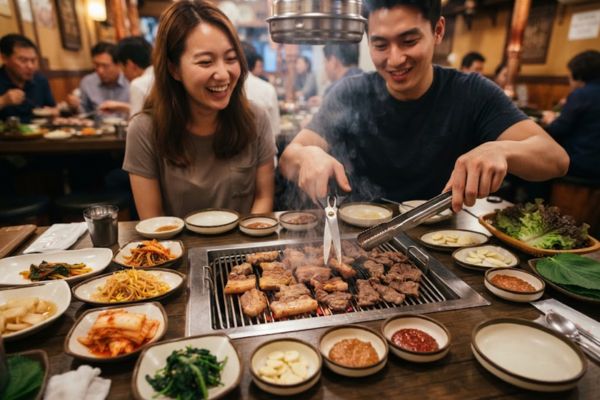
You’ll also get banchan, which are the small side dishes served alongside the meal. These can include kimchi, pickled vegetables, seasoned greens, bean sprouts, and other little dishes.
And yes, the scissors are normal.
They’re used to cut larger pieces of meat into bite-sized pieces while they’re cooking. Your first time seeing someone casually snip through pork belly with scissors is a little funny, but you’ll get used to it very quickly.
If you’re planning to explore Seoul’s food scene, Gwangjang Market is another easy place to add to your itinerary for Korean street food and local dishes.
What Should You Order?
If it’s your first time, start with samgyeopsal (pork belly).
It’s one of the easiest cuts for beginners because it’s flavorful, forgiving on the grill, and you don’t need to know much about Korean BBQ to enjoy it.
Here are a few common cuts you’ll see:
| Korean | What it is | Good for first-timers? |
|---|---|---|
| Samgyeopsal (삼겹살) | Pork belly | ⭐ Yes |
| Moksal (목살) | Pork neck/shoulder | ⭐ Yes |
| Galbi (갈비) | Marinated beef short ribs | ⭐ Yes |
| Hanwoo (한우) | Korean beef | If you want to splurge |
Samgyeopsal is the classic choice: fatty, juicy pork belly that gets beautifully crisp around the edges.
Moksal is a little leaner, so I’d pick it if you’re not a huge fan of fatty meat.
Galbi is a great option if you prefer something sweeter and more heavily seasoned because it’s usually marinated.
And if you see Hanwoo, that’s Korean beef. It’s generally much more expensive, so I’d save it for when you’re specifically looking for a premium BBQ experience.
You don’t need to order five different cuts just because the menu has them. For a first visit, one or two types is more than enough.
Want to compare a few places before deciding where to eat? Check out our guide to the best Korean BBQ in Seoul for more restaurant ideas.
How to Read a Korean BBQ Menu?
The price on a Korean BBQ menu isn’t always the price of one plate.
Some restaurants price their meat by weight, while others list a fixed portion size.
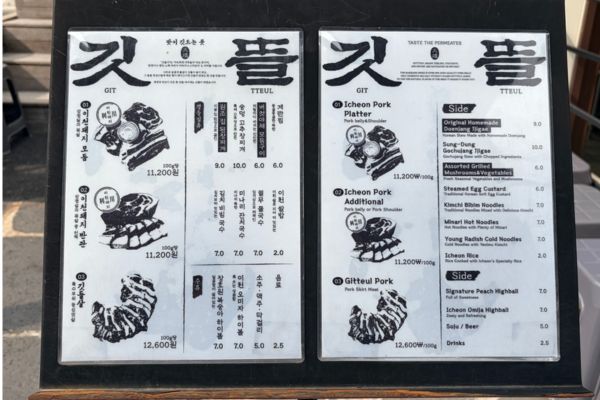
Take GIT TTEUL in Hongdae as an example. Their pork is listed at ₩11,200 per 100g, while their Gitteul Pork is ₩12,600 per 100g.
So if you see ₩11,200 on the menu, don’t assume that’s automatically the price of your whole meal. The final price depends on how much you order.
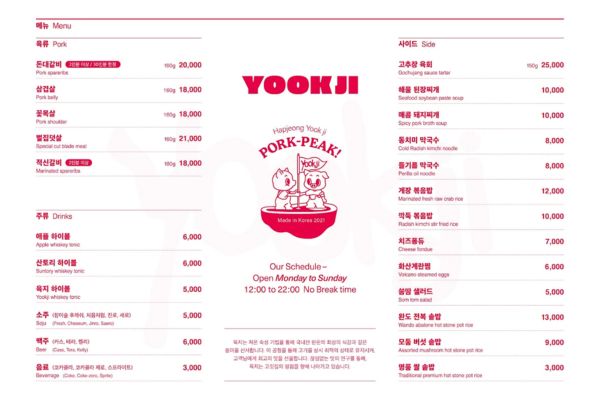
Yookji Hongdae shows the portions a little differently. Their pork belly and pork shoulder are listed at 160g for ₩18,000, while other cuts have different prices.
See the difference? That’s why it’s worth checking both the price and the weight before ordering.
Our tip: If you’re confused by the menu, just ask, “How many portions do you recommend for two people?” It’s much easier than trying to do BBQ math while everyone else is already hungry. 😂
How Much Korean BBQ Should You Order?
Start with the restaurant’s required minimum, then order more if you’re still hungry.
Korean BBQ meat is usually ordered by portion, often shown as 1인분 (inbun) on Korean menus. Many restaurants have a minimum order, commonly two portions for the table, although the exact rule varies by restaurant.
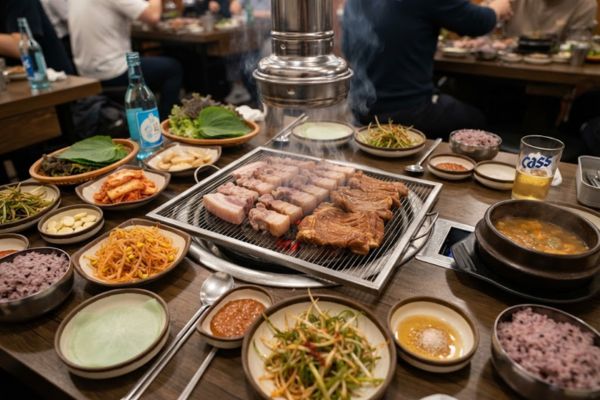
And here’s something that confused me at first: one portion doesn’t necessarily mean one complete meal.
It’s a serving unit for the meat, and restaurants can have different portion sizes.
So if you’re a group of two, a good approach is to start with the restaurant’s minimum and see how you feel. You can always order another portion.
Honestly, this is much less stressful than trying to calculate the exact amount of meat you’ll need before you’ve even sat down.
If you’re planning your Seoul days around food and sightseeing, our 3 Days in Seoul itinerary also includes a Korean BBQ stop.
Do You Cook the Meat Yourself?
Sometimes, yes, but it depends on the restaurant.
At some Korean BBQ restaurants, you’ll be given tongs and scissors and expected to cook everything yourself. At others, staff will grill the meat for you, especially at restaurants with table service or more premium cuts.
If a server starts taking over the grill, let them.
Don’t fight for the tongs like it’s a cooking competition. 😂
If you’re cooking yourself, don’t worry about being perfect either. The staff can usually help if you look confused or ask.
How Do You Eat Korean BBQ?
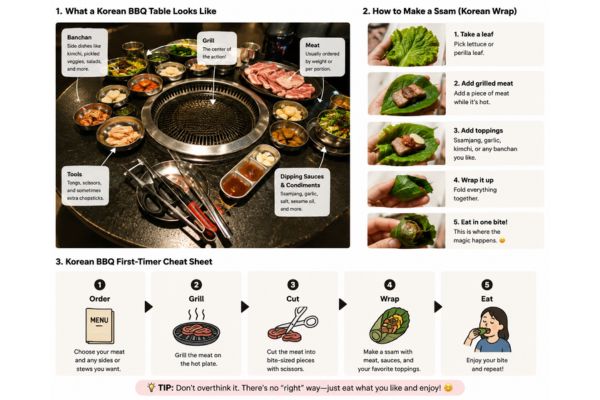
You can eat the meat on its own, but making a ssam is one of the best parts.
A ssam is basically a little wrap made with lettuce or perilla leaf.
Here’s the easy version:
1. Take a lettuce or perilla leaf.
2. Add a piece of grilled meat.
3. Add a little ssamjang.
4. Add garlic, kimchi, or another side dish if you want.
5. Wrap it up and eat.
And don’t feel like you need to recreate some perfect Instagram ssam with twelve ingredients.
Start simple: lettuce + meat + ssamjang.
Once you figure out what you like, add more.
What Are All the Side Dishes?
Those little dishes are called banchan, and they’re meant to be eaten with the meal.
You’ll usually get several small side dishes along with your BBQ. Exactly what you receive depends on the restaurant.
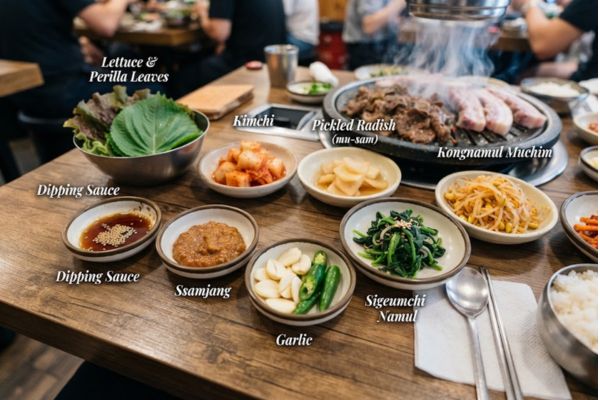
You might see:
- Kimchi
- Pickled radish
- Bean sprouts
- Seasoned vegetables
- Garlic
- Lettuce or perilla leaves
- Ssamjang
- Dipping sauces
Some restaurants offer refills of certain banchan, but don’t assume every dish is automatically unlimited. If you want more, just ask the staff.
And no, you don’t need to finish every little bowl before ordering more meat. There is no banchan exam at the end of dinner.
What Do You Do With the Scissors?
Use them to cut the meat into smaller pieces.
This is probably one of the first things foreign visitors notice at Korean BBQ.
The meat often arrives in larger pieces, particularly pork belly or other thick cuts. Once it has cooked enough to handle, the tongs and scissors make it easy to cut into bite-sized pieces.
So if someone puts scissors on your table, don’t panic.
They’re not there because the restaurant thinks you’re doing arts and crafts.
Korean BBQ Etiquette for First-Timers
You don’t need to memorize a long list of Korean dining rules.
Just follow these basics:
- Let the staff lead when it comes to the grill. If they take over, let them cook.
- Don’t mix raw and cooked meat utensils if separate tongs are provided.
- Order according to the restaurant’s minimum. It varies by place.
- Banchan is shared. Take what you want, but don’t treat the little dishes like individual appetizers.
- Don’t worry about drinking alcohol. Soju and beer are common, but you absolutely don’t have to order them.
- Tipping isn’t normally expected at Korean restaurants.
That’s honestly enough to get you through your first meal.
You don’t need to suddenly become a Korean BBQ expert before you walk through the door.
Can You Eat Korean BBQ Alone?
You can, but it depends heavily on the restaurant.
Some Korean BBQ restaurants have minimum-order or minimum-person requirements, while others are more comfortable with solo diners.
If you’re traveling alone, look specifically for restaurants that accept solo diners rather than assuming every BBQ restaurant will.
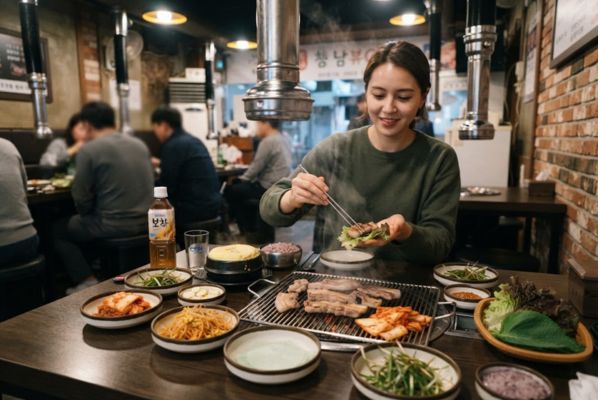
And honestly, this is one situation where checking the restaurant’s current policy before walking over can save you an awkward conversation at the door.
Can You Eat Korean BBQ Without Speaking Korean?
Yes, absolutely.
You don’t need to speak Korean to enjoy Korean BBQ.
Many restaurants have menus with photos, and you can always point to what you want. In tourist-heavy areas, you’re also more likely to find English menus or staff who can communicate in English.
Still, knowing a few words can make ordering easier:
- Samgyeopsal — 삼겹살
- Moksal — 목살
- Galbi — 갈비
- One portion — 1인분
- Two portions — 2인분
- Water — 물 (mul)
- Please give me… — 주세요 (juseyo)
You don’t need to pronounce everything perfectly. Pointing at the menu while saying “juseyo” will get you surprisingly far.
How Much Does Korean BBQ Cost in Seoul?
There isn’t one fixed price, but expect the meat to be the main part of your bill.
Current Seoul restaurant guides put typical pork BBQ around ₩15,000–₩30,000 per person, while premium beef can be considerably more expensive. Prices vary by neighborhood, meat cut, restaurant, and portion size.
A better way to think about your budget is:
Meat + rice/stew/noodles + drinks = your actual meal cost.
Don’t look at the price of one meat portion and assume that’s your final bill.
If you’re trying to keep things affordable, pork BBQ is generally a much easier starting point than premium Korean beef.
What Should You Order Besides Meat?
Start with the meat, then add rice, stew, or noodles if you still have room.
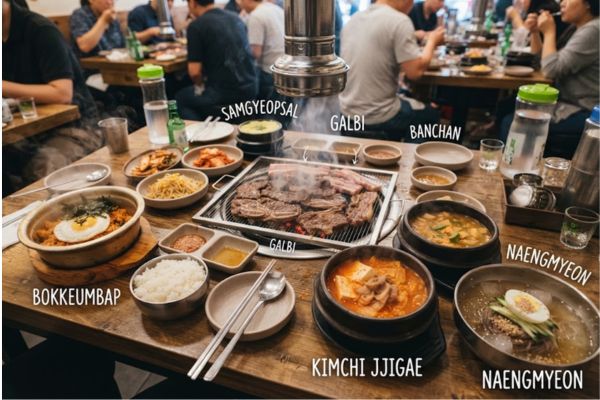
Some popular additions include:
- Kimchi jjigae — kimchi stew
- Doenjang jjigae — soybean paste stew
- Naengmyeon — cold noodles
- Bokkeumbap — fried rice, at restaurants that offer it
Personally, I wouldn’t order everything at once.
Get the BBQ going first. Eat a little. Then decide whether you actually have room for more.
Korean BBQ has a funny way of making the table look manageable at first and then suddenly you’re surrounded by meat, banchan, rice, drinks, and one suspiciously ambitious bowl of stew.
What Should You Know Before Your First Korean BBQ?
The biggest tip is simple: don’t overthink it.
You don’t need to know every meat cut, understand every Korean word, or build the perfect ssam on your first attempt.
Start with samgyeopsal, follow the restaurant’s lead, order a reasonable amount, and add more as you go.
Once the grill starts sizzling, you’ll probably realize the whole thing is much easier than it looked from the outside.
And honestly, that’s part of the fun.
FAQ About Korean BBQ
- What is the best Korean BBQ meat for first-timers?
Samgyeopsal is an easy starting point because it’s flavorful and simple to grill. - Do you cook Korean BBQ yourself?
Sometimes. Some restaurants have staff grill the meat, while others expect you to cook it yourself. - How many portions should I order?
Start with the restaurant’s minimum, which is often two portions for the table, then order more if needed. - Are Korean BBQ side dishes free?
Banchan is generally included with the meal, although restaurant policies on refills can vary. - Do you tip at Korean BBQ restaurants?
Tipping is not normally expected in Korea. - Can I eat Korean BBQ alone?
Sometimes, but some restaurants have minimum-person or minimum-order requirements. Check before visiting. - Do I need to speak Korean?
No. English menus, pictures, pointing, and a few simple Korean words are usually enough to get started.