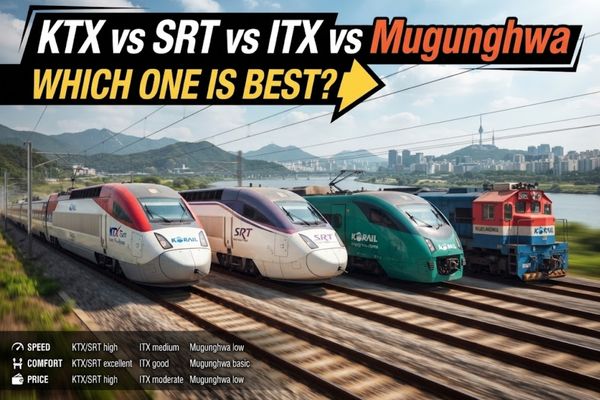
When I first started exploring Korea, figuring out the train system felt a bit overwhelming.
KTX, SRT, ITX, Mugunghwa. I didn’t know the differences and just wanted to get from one city to another without overthinking it.
If that’s you right now, don’t worry. I’ve taken all these trains, and in this guide, I’ll walk you through what each one is like, who they’re good for, and how to choose the one that fits your travel plans.
Types of Trains in Korea
1. KTX (Korea Train Express)

KTX is Korea’s high-speed train and the fastest way to travel between major cities. It reaches up to 305 km/h (190 mph) and connects key destinations like Seoul, Busan, Daegu, Daejeon, and more.
What I Like:
- Seoul to Busan in about 2.5 hours
- Easy departures from Seoul Station
- Clean, comfortable, and well-maintained trains
Useful to Know:
- KR Pass works on KTX
- Seats must be reserved
- Slightly more expensive than other options, but worth it if you’re short on time
For most first-time visitors traveling between major Korean cities, KTX is probably the easiest option to understand. If you’re trying to fit several cities into a short trip, the faster journey can make a noticeable difference.
2. SRT (Super Rapid Train)

SRT is another high-speed train operated separately from KTX. It covers many of the same major-city journeys but departs from Suseo Station in southeastern Seoul, which can be particularly convenient if you’re staying around Gangnam or southern Seoul.
What I Like:
- Usually a bit cheaper than KTX
- Trains are just as fast and comfortable
- Convenient if you’re staying in southern Seoul
Heads Up:
- KR Pass is NOT valid on SRT
- If you’re closer to Seoul Station, it might be less convenient
The important thing to remember is that SRT isn’t necessarily a “better KTX.” For many travelers, the deciding factor is simply which station is easier to reach from their hotel.
3. ITX (Intercity Train Express)

ITX trains are slower than KTX and SRT and are mainly useful for regional journeys. Two services travelers commonly come across are ITX-Cheongchun and ITX-Saemaeul.
What I Like:
- Affordable and comfortable
- Reserved seats available
- Great for day trips from Seoul
Notes:
- Travel time is longer than KTX or SRT
- Runs less frequently than high-speed trains
One popular example is ITX-Cheongchun, which is useful for getting toward the Chuncheon and Gapyeong area. If you’re visiting Nami Island, remember that the train doesn’t take you directly to the island—you’ll need to continue from the station after getting off.
4. Mugunghwa Train

Mugunghwa is a slower conventional passenger train and is one of the more budget-friendly options for traveling around Korea.
It makes more stops than high-speed trains, which means it can be useful if you’re heading somewhere that isn’t served directly by KTX or SRT.
What I Like:
- Very budget-friendly
- Connects to less touristy destinations
- Feels more local and relaxed
Be Aware:
- Trains are older
- Travel time is the longest among all options
- Some trains may not have assigned seats
I wouldn’t automatically choose Mugunghwa just because it’s cheaper. For a long journey like Seoul to Busan, the extra travel time can eat up a big part of your day. But for shorter regional trips, it can be a nice way to slow things down.
Quick Comparison Table
| Train | Speed | Price | KR Pass | Best For |
| KTX | Fastest | High | ✅ Yes | Long-distance, time-saving |
| SRT | Fast | Slightly lower | ❌ No | Budget-friendly from Gangnam |
| ITX | Medium | Moderate | ✅ Yes | Day trips, regional destinations |
| Mugunghwa | Slowest | Lowest | ✅ Yes | Budget travel, local feel |
The easiest way to think about it is KTX and SRT are for speed, ITX is for regional trips, and Mugunghwa is for travelers who don’t mind taking things slower.
KTX vs SRT, What’s the Difference?
This is probably the comparison that matters most if you’re traveling between major cities.
Both are high-speed trains, and the journey itself can feel quite similar. The biggest practical difference for a tourist is often where the train leaves from.
KTX has several major stations depending on your route, with Seoul Station being the obvious choice for many travelers. SRT departs from Suseo Station, which can be more convenient if you’re staying around Gangnam or southeastern Seoul.
Price can also differ slightly, with SRT often being cheaper on comparable routes.
So if you’re staying near Seoul Station and the KTX schedule works for you, I’d probably choose KTX rather than crossing Seoul just to save a little money.
On the other hand, if you’re staying near Gangnam, SRT can make a lot of sense because you’re already much closer to Suseo.
In other words, don’t just compare the ticket price. Compare the entire journey from your hotel to the station.
Arriving at Incheon Airport?
If you’re staying near Seoul Station, the AREX Express is one of the easiest ways to get into the city before catching your KTX. → AREX Incheon Airport Express Voucher
How Much Does Train Travel in Korea Cost?
Train prices in Korea depend on the route, train type, and class you choose.
KTX and SRT generally cost more than ITX and Mugunghwa, but they can be worth paying for when you’re traveling a long distance.
For example, if you’re traveling from Seoul to Busan, I’d rather pay more for a high-speed train and arrive in roughly a few hours than spend most of the day on a slower service.
For shorter regional trips, however, the price difference can make slower trains more appealing.
If you’re planning several long-distance journeys, it’s also worth comparing the total cost of individual tickets with a KR Pass, especially if you’re eligible to use one. Don’t assume the pass is automatically cheaper, calculate the journeys you actually plan to take first.
Planning several train trips? You can check the KORAIL Pass here.
Which Train Should You Take for Popular Destinations?
Instead of memorizing every train type, it can be easier to start with your destination.
Seoul to Busan
KTX or SRT is the obvious choice if you want to get there quickly.
Both are high-speed options, and the journey takes around 2.5 hours, so I’d choose based on the departure station, schedule, and price rather than assuming one is always better.
Seoul to Daegu
Again, KTX or SRT makes the most sense if your priority is getting there quickly.
For a long-distance trip like this, I wouldn’t choose a slower train unless saving money is more important than saving time.
Seoul to Gangneung
KTX is the convenient option for this route and makes a day trip or short stay much more realistic.
It’s also one of those journeys where taking the train can be much easier than trying to fit a long bus journey into your itinerary.
Seoul to Chuncheon or the Nami Island Area
ITX-Cheongchun is a popular option for getting toward Chuncheon and Gapyeong.
Just remember that Nami Island itself isn’t directly connected to the train station. You’ll need to continue your journey after arriving in the area.
Seoul to Smaller Regional Destinations
This is where slower trains such as Mugunghwa can become useful.
They make more stops and can connect you with places that aren’t served directly by high-speed trains.
If you have plenty of time and enjoy seeing a different side of Korea, this can be part of the experience rather than simply a compromise.
Do You Need to Book Korean Trains in Advance?
For popular routes, I would.
You can sometimes buy tickets closer to the departure date, but I wouldn’t leave everything until the last minute if your itinerary depends on a specific train.
I’d especially book ahead when:
- You’re traveling between Seoul and Busan
- You’re traveling on a weekend
- You’re visiting during a busy holiday period
- You need a particular departure time
- You’re traveling with several people and want to sit together
This is especially important when you have a tight itinerary. Missing the train you wanted can mean rearranging an entire day of your trip.
For less popular regional journeys, you usually have more flexibility.
The easiest approach is to decide your important long-distance journeys first, then build the rest of your itinerary around them.
Which Train Should You Take?
Here’s how I usually decide:
- Short on time? Go with KTX or SRT.
- Staying around Gangnam? SRT may be more convenient.
- Staying near Seoul Station? KTX is usually the simpler choice.
- Going to Busan? KTX or SRT.
- Going to Gangneung? KTX.
- Planning a trip toward Chuncheon or Gapyeong? Look at ITX-Cheongchun.
- Want to spend less and don’t mind a longer journey? Consider Mugunghwa.
- Exploring smaller regional destinations? Check whether a slower train serves your route.
The most important thing is not to choose a train just because someone says it’s “the best.”
Look at your hotel location, destination, departure time, budget, and how much time you have in Korea.
Sometimes paying a little more for KTX is absolutely worth it. Other times, a slower train is perfectly fine.erience, so it really depends on your trip goals, budget, and the vibe you’re after.
➡️ Want a complete overview? Check out my full train travel guide here.
Final Thoughts?
Korea’s trains are clean, safe, and very reliable. Whether you’re zipping across the country or enjoying a slower scenic ride, you’re in for a good experience.
My advice? Pick the train that matches your itinerary, and don’t stress too much. You’ll get where you’re going, and maybe even enjoy the journey more than you expected.
Related reads:
- How to Book & Ride KTX in Korea (For First-Timers)
- Are Korea Rail Passes Worth It?
- T-Money vs KR Pass vs Regular Tickets – Which One Should You Choose?